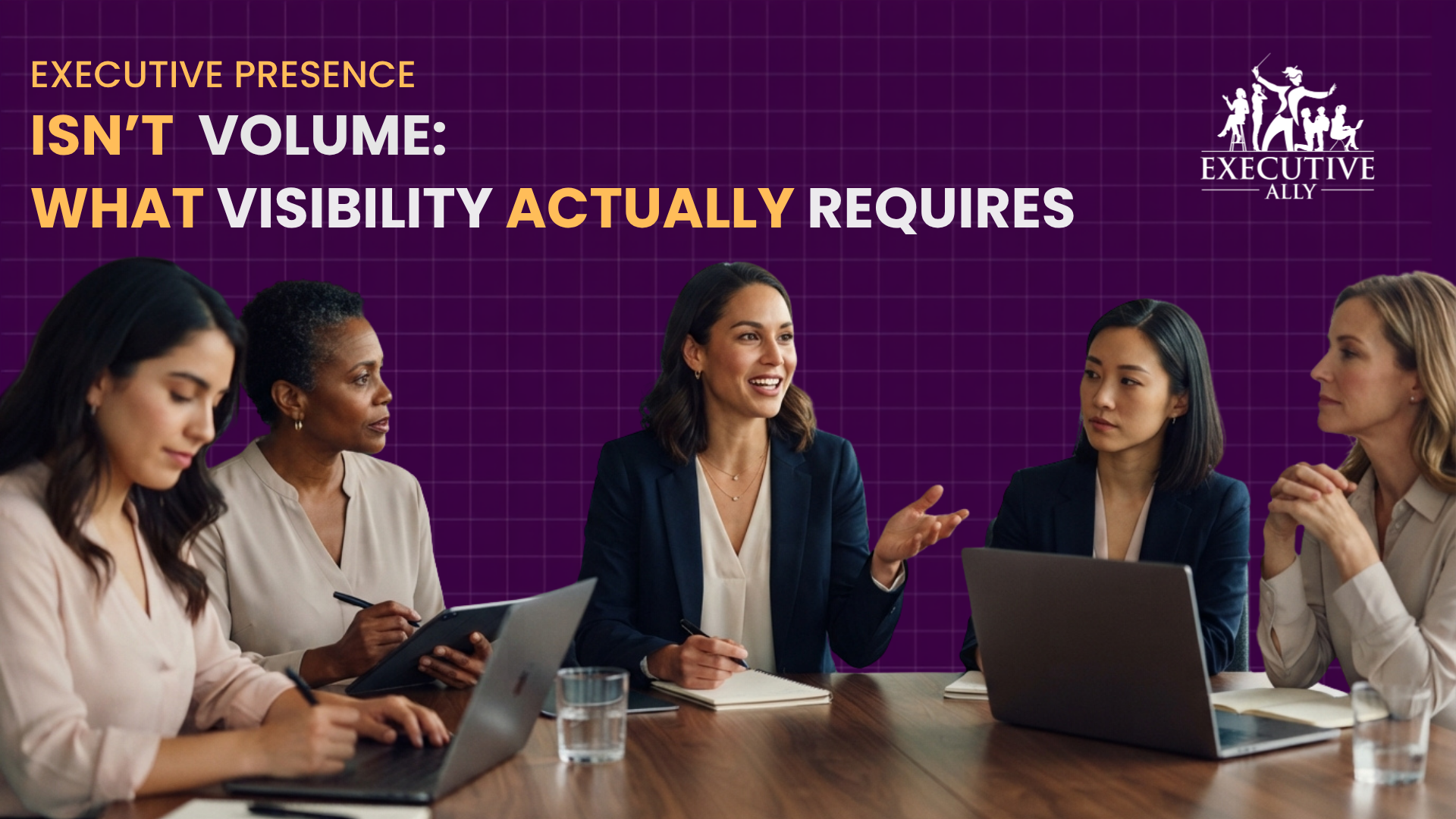
Somewhere along the way, being seen as a leader got confused with being the loudest person in the room. They're not the same thing, and confusing them costs women promotions they've already earned.
Executive presence isn't a vague vibe. It's been studied directly.
Sylvia Ann Hewlett, founder of the Center for Talent Innovation, led research spanning forty focus groups and interviews with senior leaders. The research broke executive presence into three measurable components: gravitas (roughly two-thirds of the judgment), communication (about a quarter), and appearance (around 5%).
What the research doesn't say as often: most people who get flagged for "lacking presence" aren't missing all three. They're usually strong in one or two, and have a specific, identifiable gap in the third.
This shows up as being technically excellent but not read as decisive. You know the material cold, but hesitate to state conclusions plainly, or hedge them once stated.
- Notice if you're respected for competence but rarely asked to make the call
- Watch for over-qualifying a conclusion you're actually sure of
- This gap is about ownership of a position, not knowledge of it
This shows up as having strong instincts and judgment that don't reliably translate into what the room hears. The thinking is there. The delivery doesn't carry it.
- Notice if people ask you to "say more" or seem confused by conclusions that felt clear to you
- This is often not a confidence issue, it's a translation issue between internal certainty and external clarity
This is the smallest factor by far in Hewlett's research, but it's about whether your presentation matches the room you're in, not about superficial polish. It shows up as being underestimated on sight before you've said a word.
- This gap is real, but it's the one least worth over-investing in, given how little it actually weighs
- Awareness matters more here than effort
Generic advice to "develop more gravitas" often restates the problem as the solution. It doesn't tell you which of the three gaps is actually costing you.
Most women who feel like their presence isn't landing aren't under-confident across the board. They're strong in gravitas and communication, and underestimated on context, or strong in gravitas and weak in expression, so their sound judgment never quite reaches the room clearly.
Knowing which gap is yours changes what you actually practice.
Presence isn't one trait you either have or don't. It's three separate skills, weighted unevenly, and most people are already strong in at least one.
The room doesn't need you to become someone else. It needs the gap identified and closed, one specific skill at a time.
Inside SheAscends™: Growth Mindset for Emerging Women Leaders, we help emerging leaders identify which gap is actually theirs, and build the specific, practiced habits that close it.
The course is free to join, for a limited time only.